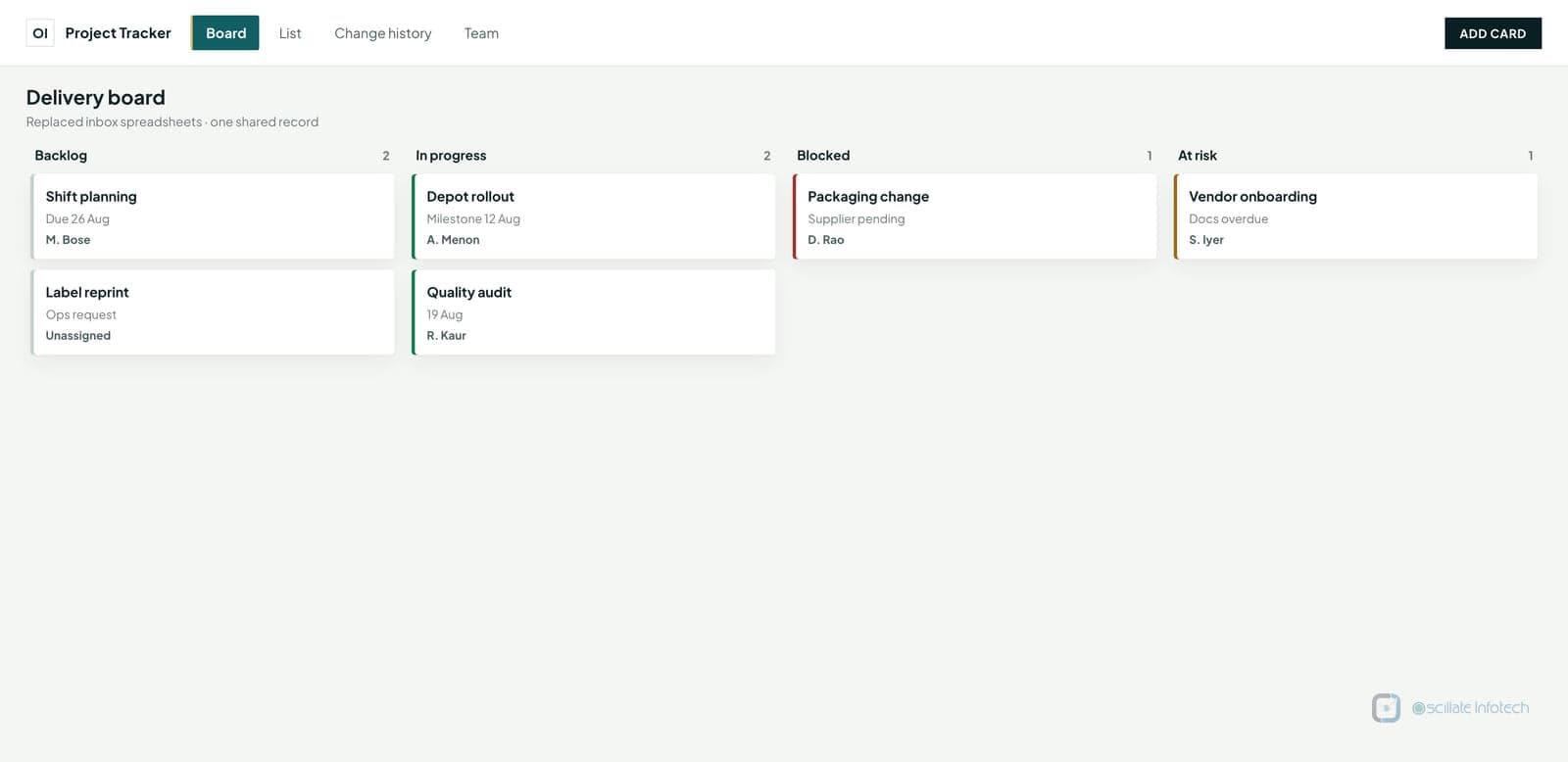
Most software decisions should start with a product that already exists. Accounting, email, HR, generic CRM, and commodity project tracking have mature markets. Buying there is usually faster, cheaper, and less risky than writing your own. Custom development is not a badge of seriousness - it is a cost you take on when the gap between the product and the work is structural.
Buying first is usually the sensible starting point
Look at what the market already sells before you sketch screens. If two or three products cover the must-have workflows with change management your team can absorb, buy. Low-code or no-code tools fit the same pattern when the process is simple, volumes are modest, and you accept platform limits.
Reproducing a mature commercial product from scratch without a strong operational reason is how projects burn years and still ship a worse version of something you could have subscribed to.
Where standard software works well
SaaS and packaged tools earn their keep when your process is close to the vendor’s default, rollout speed matters more than perfect fit, and you want someone else to host, patch, and push upgrades. CRM for a standard sales cycle, cloud accounting for ordinary books, a common helpdesk for ticket queues - these are rarely where custom software pays off.
Configurable off-the-shelf software sits in the middle: you turn on modules, set fields, and map roles. That is still buying. Configuration is not the same as owning the product’s roadmap.
When configuration becomes a pile of workarounds
The tipping point is not “we dislike the screens.” It is when staff live in spreadsheets beside the system, re-key the same order into three tools, or maintain shadow processes the vendor never intended. Extra licences, paid connectors, and vendor consultants stack up. Month-end still needs a reconciliation ritual because the product’s model does not match drop-ship, consignment, multi-stop dispatch, or whatever actually moves money for you.
At that stage you are no longer adapting the business lightly to software - you are paying forever to paper over a misfit. That is when a focused custom piece becomes worth estimating, not when someone prefers a different button colour.
Subscription price is not the full cost
Licence fees are visible. Operating cost is often larger: duplicate entry, manual reconciliation, spreadsheet bridges, idle time waiting on exports, forced process compromises that slow the floor, and people hired to babysit integrations the product almost supports.
Custom software has its own bill: build, hosting, maintenance, security patches, and whoever answers the phone when it breaks at peak season. Owning source code does not remove that. It changes who you depend on - from a vendor’s release cycle to your own team or a development partner.
When custom becomes defensible
Build (or commission) an internal application when the workflow is materially different from what products assume, commercially important, and expensive to fake with workarounds. Deep integration with systems you already run, data that must stay under your control, or business rules that change often enough that waiting on a vendor roadmap hurts - these tip the case.
A specialty operation that tried a mainstream package, grew “enterprise” modules and CSV bridges, and still cannot express how orders actually flow is a familiar pattern. The useful answer is rarely “replace everything.” It is often a narrow tool for the differentiating slice, synced to systems of record that stay bought.
When building would be wasteful
Do not build because users dislike an interface they have not learned. Do not automate a process nobody can describe on a whiteboard. Do not start a multi-year clone of a mature SaaS category because the sales demo felt limiting. If the process is still inventing itself every week, buy something adequate or leave it manual until the rules settle.
Internal capacity matters. A custom system without named owners for change, backup, and support becomes another single point of failure - just one you wrote yourself.
Ownership and lock-in on both sides
SaaS lock-in looks like data export pain, proprietary connectors, and process habits shaped around the vendor. Custom lock-in looks like undocumented code, a sole developer, and frameworks nobody else wants to touch. Exportability, documentation, and an exit path belong in the decision either way.
Security and compliance do not vanish with a purchase or a build. With SaaS you inherit the vendor’s controls and accept their limits. With custom you inherit patching, access control, audit logging, and support responsibility - or you pay someone to carry them.
Hybrid is often the practical answer
Keep email, HR, and accounting on products that are good enough. Put custom effort where the operation creates advantage or where misfit burns cash every week - order exceptions, warehouse screens, specialised reporting, the dispatch rules a generic TMS will not hold. Purity is rare; mixes evolve as the business grows.
Low-code can sit in that mix for internal forms and light workflows. It is neither a universal answer nor unprofessional. It fails when you need complex concurrency, hard audit trails, or integrations the platform fights.
A decision frame before you commit budget
Work through these without turning them into a fake score:
How standard is the workflow? Does it create competitive value, or is it plumbing? How many users, and are they internal only? How deep must integrations go? How sensitive is the data, and who must control it? How often do rules change? What do current workarounds cost in hours and errors? What happens if the system is down for a day? Are suitable products actually available? Who will own a custom system for five years? What is the expected useful life, and how would you leave - export, migration, or rewrite?
If the honest answers point at a common process with acceptable products, buy. If they point at a structural gap you can name and price, estimate a focused build. If they are muddy, fix the process description first.
How we evaluate build-versus-buy work
At Oscillate Infotech we start from the operational problem and the cost of today’s workarounds - not from a preference for writing code. That usually means mapping must-have workflows, naming what can stay on SaaS, and sizing only the slice that needs custom behaviour or integration.
Custom internal tools and software development on our services list are for that slice. A short written look at one process - where the product ends and the spreadsheet begins - is enough to decide buy, configure, build, or leave alone before anyone commits a budget.